
A baseball cap looks simple, but a custom one goes through a dozen separate jobs before it lands in a carton. At Cap Empire, the custom hat brand of Yangzhou New Chuntao Accessory Co., Ltd., every cap order follows the same 12 steps in our factory in Yangzhou, China. This guide follows a structured six-panel cap from the fabric store to the warehouse. It explains what each part of a cap is made of and which of your decisions are locked in at each step. If you want the buyer’s view instead, our guide to how a custom hat order works covers each stage from brief to delivery.
What a baseball cap is made of
Before following the production line, it helps to know the parts. Every one of them is something you can specify.
| Part | What it is | What you choose |
|---|---|---|
| Crown | The part that covers the head, sewn from panels. Most baseball caps have six panels; a five-panel cap has one wide front panel. | Fabric, color of each panel, crown height, five or six panels |
| Front backing | A stiff layer behind the front panels that makes the front stand up on a structured cap. Unstructured caps, such as dad hats, have no stiff backing and sit softer and lower. | Structured or unstructured |
| Eyelets | The small stitched holes in the crown panels that let air through. | Eyelet color |
| Top button | The fabric-covered button where the panels meet at the top of the crown. | Button color |
| Brim | A stiff insert, usually a plastic board, covered in fabric on top and underneath. The underside is called the undervisor. | Flat or curved brim, brim and undervisor colors |
| Sweatband | The band sewn around the inside edge of the crown, against the forehead. | Plain or printed with your brand |
| Closure | How the cap adjusts at the back. | Snapback, fabric strap with buckle, hook-and-loop, or a fitted cap with no closure |
| Labels | Woven labels, printed labels and hang tags. | Your own labels, or none |
For the crown and brim, baseball caps are most often made in cotton, canvas, corduroy, denim or polyester, and we also make them in recycled RPET fabric. Our range runs to more than 100 fabrics, and any color can be matched to a Pantone reference you send. Trucker hats swap the back panels for mesh.

The 12 steps, from fabric to warehouse

1. Raw materials
Production starts by gathering everything your order needs: the fabric in your colors, mesh if it is a trucker hat, the brim inserts, sweatbands, closures and your labels. Fabrics and colors we already hold move fastest. Fabric dyed to your Pantone, or special trims made for your order, have to arrive before anything else can start, so they are the first thing to settle.
2. Cloth inspection
Before any cutting starts, the fabric is inspected. This is the first of three quality checks on every order. A problem caught here costs a length of fabric; caught later, it costs finished caps.
3. Cutting
The crown panels and brim pieces are cut to the pattern for your cap. The pattern sets the shape: crown height, the number of panels and the brim outline. That is why the shape has to be agreed on the sample before bulk production, because changing it afterwards means a new pattern.
4. Laminating
On a structured cap, the front panels get their stiff backing at this step, which is what lets the front of the cap stand up and hold a logo flat. On an unstructured dad hat, the front stays soft, which gives it a relaxed, lower fit.

5. Embroidering
Your logo is embroidered while the panels are still flat, before the cap is sewn together. For you, that means the logo’s size, position and thread colors must be final before this step: once a panel is embroidered, a change means cutting and embroidering new panels. To choose between thread, a patch and ink, read our guide to embroidery, patches and printing. Printed logos are made in our printing workshop.
6. Eyelets
The small air holes are stitched into the crown panels, usually one per panel. You can match the eyelets to the fabric or pick a contrast color.
7. Sewing
The panels are joined into a crown, the brim and sweatband are sewn on, and the closure is attached. Inside the cap, the seams are covered with tape for a neat finish. This is the step where the cap first looks like a cap.
8. Inspection
The sewn caps are checked before they go any further. This is the second quality check: stitching inside and out, loose threads, whether the panels line up evenly, and whether the logo sits where the drawing shows it.
9. Buttoning
The top button goes on at the point where the panels meet. It covers the ends of the seams, and it is one more place for a color detail.
10. Ironing
Each cap is pressed and shaped with heat so the crown takes its final form and the brim keeps the flat or curved shape you chose.
11. Final inspection
The finished caps are checked against the sample you approved. This is the third quality check, and the approved sample is the standard: the bulk order should look like it. An independent inspection by a third-party company can also be arranged before the caps ship, if you want one.
12. Warehousing
The caps are packed the way you asked, with any hang tags, polybags or barcode stickers, then stored ready for shipping. Yangzhou is not far from Shanghai port.
Which of your decisions is fixed at which step
Most of these choices are agreed on the drawing and confirmed on the sample long before bulk production starts. The table shows why: each decision is used at a specific point on the line, and a late change has to go back to that point.
| Your decision | Needed by |
|---|---|
| Fabric type and colors (Pantone) | Step 1, raw materials |
| Crown height, number of panels, brim shape | Step 3, cutting |
| Structured or unstructured front | Step 4, laminating |
| Logo method, size, position and thread colors | Step 5, embroidering |
| Eyelet, button, undervisor and sweatband colors; closure; labels | Steps 6 to 9 |
| Packing, hang tags, barcodes and carton marks | Step 12, warehousing |
How other cap styles differ
The 12 steps are the same for every baseball cap, but some styles change what happens at certain steps:
- Dad hats are unstructured and low, and many are garment-washed, which means the cap is washed after it is sewn. That is why washed caps vary a little from piece to piece. See our custom dad hats and washed and distressed finishes.
- Trucker hats use mesh for the back panels, so they stay cool and leave the front panels free for a logo. See our mesh trucker hats.
- Snapbacks have a flat brim and an adjustable snap closure at the back. See our custom snapback hats.
- Sun visors have no crown at all, only a brim and a band. See our washed sun visors.
Bucket hats and beanies are made differently from baseball caps. A bucket hat has a soft brim that goes all the way round, and a beanie is knitted rather than cut and sewn. See our bucket hats and beanies.
How long it takes
Every new design starts with a sample. One style takes about 7 days to sample, several styles at once about 10 days, and complex designs about 14 days. Our guide to custom hat samples explains what to send and what to check. Once you approve the sample, bulk production takes about 30 days; add shipping time to that. The minimum is 100 pieces in each color.
See the line for yourself
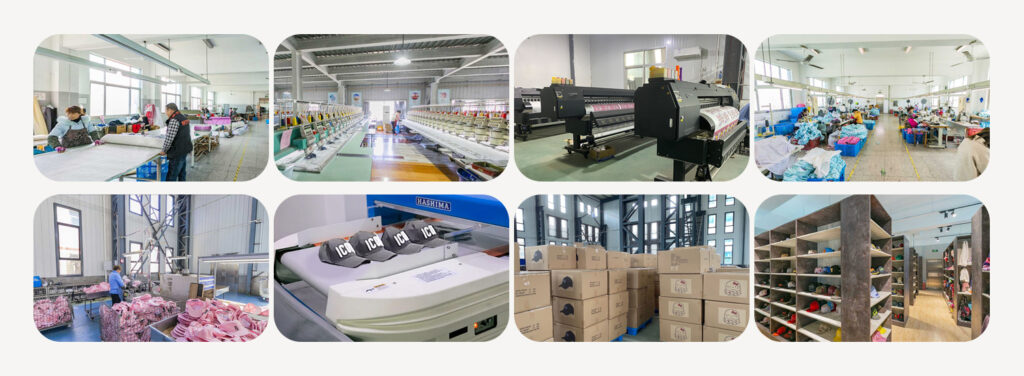
The New Chuntao factory has more than 300 machines and about 300 workers on 12,000 square meters, and turns out about 500,000 caps a month. Cutting, embroidery, printing and sewing are done in separate workshops. You are welcome to visit our hat factory in Yangzhou, or ask for a live video tour of the workshops if you cannot travel. Samples are also on show at our Canton Fair booth in Guangzhou.
FAQ
What are baseball caps made of?
A crown of five or six fabric panels, a brim with a stiff insert covered in fabric, a sweatband inside, small eyelets for air, a top button and a closure at the back. The most common crown fabrics are cotton, canvas, corduroy, denim and polyester; we also make caps in recycled RPET fabric.
What is inside a baseball cap brim?
A stiff insert, usually a plastic board, covered with fabric on top and on the underside. The underside, called the undervisor, can be a different color from the top.
Is the logo embroidered before or after the cap is sewn?
On our caps, logos are embroidered on the flat panels before the cap is sewn together. That is why the logo’s size and position have to be final before production starts.
How long does it take to make custom baseball caps?
About 7 days for a sample of one style, then about 30 days of bulk production after you approve the sample, plus shipping time.
How many caps do I need to order?
At least 100 pieces in each color.
Can I see how my caps are made?
Yes. You can visit our factory in Yangzhou, or we can show you the workshops on a live video call.
Start your cap order
Tell us the cap style, logo, colors, quantity per color and the date you need the caps, using our contact page. Our team answers with a drawing and a price, and makes a sample for your approval before any bulk work begins. To browse styles first, see our custom baseball caps, or read about private label hat manufacturing.
